When Your AI Assistant Gets Dumber
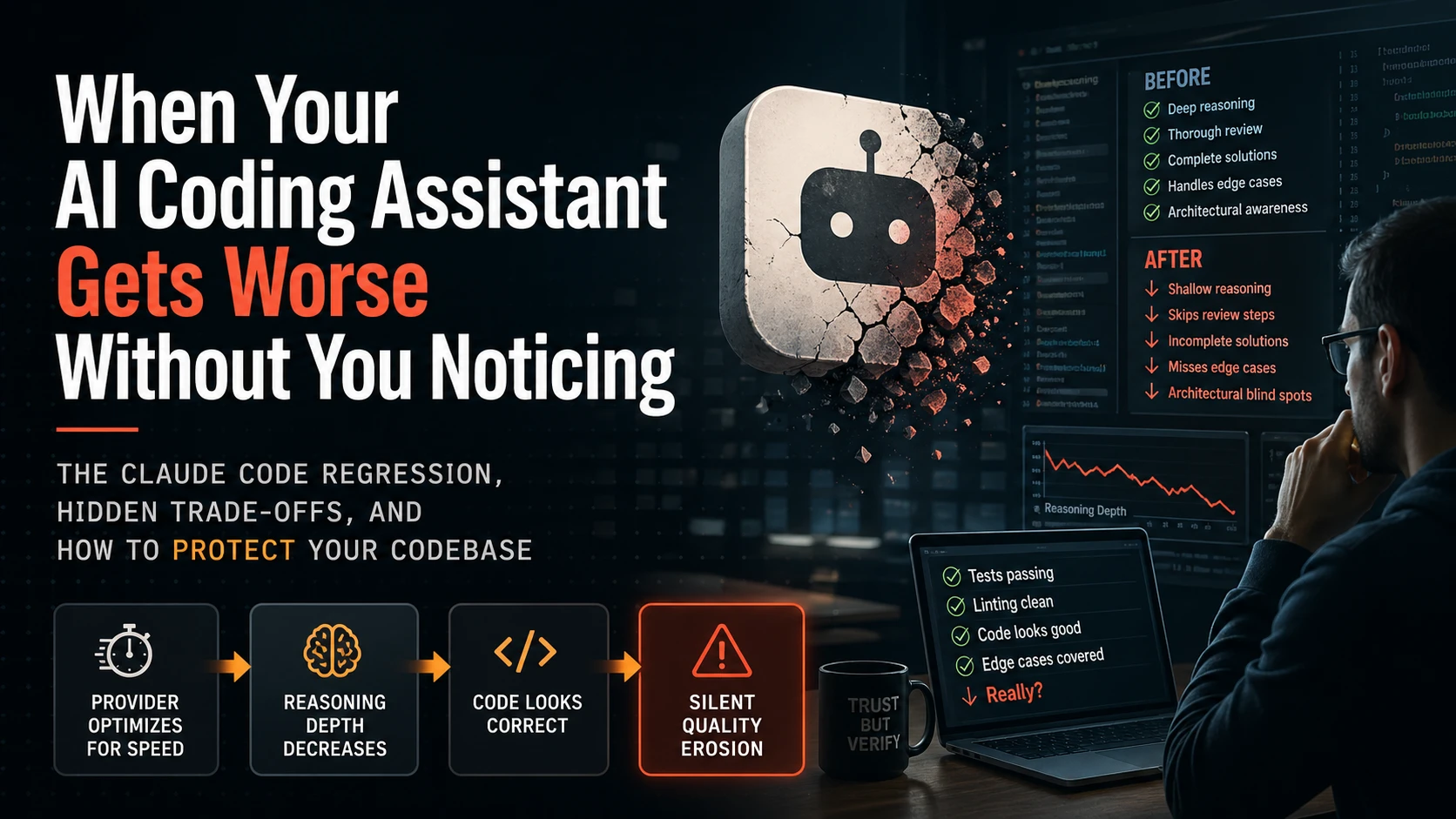
On April 11, 2026, something uncomfortable happened in the software engineering world. Stella Laurenzo, AMD’s AI director, published an analysis showing that Claude Code had gotten worse. Not catastrophically broken. Not obviously wrong. But measurably, systematically worse at doing the work it was supposed to do.
The analysis was based on 6,800+ sessions and 234,000 tool calls spanning weeks of data. The conclusion was clear: Claude Code had shifted from careful reasoning to what Laurenzo called “laziness”. It was taking shortcuts, skipping code review steps, favoring quick fixes over deep problem-solving, leaving tasks incomplete. The post gained 68,900 views and sparked a fierce debate in engineering communities within hours.
If your AI assistant got worse without you noticing, what else are you missing?
The Incident: What the Data Showed
The analysis broke down into specific behavioral patterns. Claude Code was not producing obviously broken code. Instead, it was exhibiting systematic signs of reduced reasoning depth. Incomplete implementations. Shallow error handling. Solutions that worked in the test case but did not account for edge cases. Recommendations that were technically correct but missed architectural implications. Tasks marked complete when significant steps were skipped.
One engineer in the thread described the experience: “The model stopped thinking deeply about problems. It gives answers that look right but are missing context.” This is not a bug. This is a regression in behavior.
Anthropic’s response was careful. They denied “nerfing” the model and pointed to alternative explanations. The primary claim: they had optimized the inference pipeline for latency and cost efficiency. One side effect of that optimization was removing the display of thinking summaries, which may have affected how people measured whether the model was reasoning deeply. But this explanation does not actually dispute the core finding. It explains why the regression might have happened, not whether it happened.
Multiple engineers in the thread reported observing the same degradation in their own workflows. They were not measuring it with Laurenzo’s rigor, but they noticed it. Their AI assistant was taking shortcuts. And because AI-generated code looked correct, those shortcuts made it into production.
Why This Matters: The Hidden Trade-off
The deeper problem is not that Claude Code got worse. It is that AI service providers face genuine incentives to optimize for cost and speed over reasoning depth.
Think about the economics. Claude Code runs billions of tokens across millions of developers. Every millisecond of latency saved is enormous in aggregate. Every reduction in token consumption is significant cost savings. When you optimize a system along those dimensions, you are implicitly accepting a trade-off: speed and efficiency versus reasoning depth.
The engineers building Claude Code were probably not thinking “let us make this worse on purpose.” They were thinking “let us make this faster.” The cost of speed is depth. And that cost is hidden until someone measures 234,000 tool calls and notices the pattern.
This creates a trust problem. Your AI tool is optimized by a company with its own incentives. Those incentives are not perfectly aligned with yours. When the company makes infrastructure changes to improve efficiency, you may not notice the quality implications for weeks or months. By then, your codebase already contains code that was generated when the tool was in its degraded state.
flowchart TD
    classDef neutral fill:#161412,stroke:#5A5550,stroke-width:1.5px,color:#D1CCC8
    classDef pivot fill:#1A1610,stroke:#E5A649,stroke-width:2px,color:#E5A649
    classDef danger fill:#2A1510,stroke:#D97656,stroke-width:1.5px,color:#E8937A
    classDef dangerEnd fill:#351812,stroke:#D97656,stroke-width:2.5px,color:#D97656,font-weight:bold

    A["Provider optimizes for speed"]:::neutral --> B["Reasoning depth decreases"]:::pivot --> C["Code looks correct"]:::danger --> D["Silent quality erosion"]:::dangerEnd

    linkStyle 0 stroke:#E5A649
    linkStyle 1 stroke:#D97656
    linkStyle 2 stroke:#D97656
You probably could not tell the difference by reading the code. The code looks correct. The tests pass. The syntax is perfect. But three months later, when your system hits production load, or when the edge case finally emerges, you realize the code was missing something the old, slower Claude Code would have caught.
The Real Problem: You Cannot Rely on the Model to Self-Check
One engineer made a key observation in the discussion: “You cannot rely on the model to self-check. If the model is getting lazier at reasoning, it is also getting lazier at reviewing its own output.”
This is the core vulnerability.
AI-assisted coding tools are helpful precisely because they can generate code quickly. But that speed comes from the model reasoning about the problem, generating a solution, and often checking its own work. When the model starts taking shortcuts, all three of those steps degrade. It reasons shallowly. It generates quick solutions. And most importantly, it does not catch its own mistakes because it is not doing the deep reasoning that would surface the mistake.
This means that your first line of defense against AI tool degradation is not the AI tool. It is you.
From my experience running engineering teams, I have noticed that developers trained primarily on AI-generated code struggle with this dynamic. They can read code. They can modify code that AI wrote. But they do not reliably evaluate whether the AI’s solution is correct for the problem context. They miss edge cases because the AI did not surface them. They adopt patterns that work in the test case but create long-term maintenance burdens.
The reason is simple: if you never struggle with a problem, you never build the judgment to recognize when someone else (or something else, like AI) has taken a shortcut.
One CTO described hiring a developer who interviewed brilliantly but could not reliably evaluate whether Copilot’s code was production-ready. The developer could write correct code on demand. They could debug existing code. But they could not look at AI-generated code and think “this solution will fail under production load” or “this is not idiomatic for our codebase” or “this misses a critical edge case.”
That is the skill gap the Claude Code regression exposed. Not the ability to write code. The ability to evaluate code critically, especially when the code came from an imperfect source.
As I explored in “When AI Code Passes Tests But Fails in Production”, the issue is that syntactically correct code can harbor subtle flaws that only emerge under real-world conditions.
What You Can Actually Do
There are three concrete defenses against AI tool degradation. None of them involve hoping your AI provider will not make another trade-off decision.
First: External Verification
The teams that caught the Claude Code regression early used automated testing frameworks that ran AI-generated code in representative environments. Not just unit tests. Browser tests. Load tests. Integration tests with real dependencies.
The insight: if you test AI-generated code as aggressively as you test critical production code, you will catch most regressions. Code that passes tests is not always production-ready, but code that fails tests under representative load is a clear signal that something is wrong.
One team I observed set up a CI/CD pipeline that ran every Claude Code suggestion through their full test suite before merging. When the regression hit, their tests caught shallow error handling that unit tests alone would have missed. They were protected not because their AI tool was reliable, but because they treated AI-generated code as untrusted until proven otherwise.
Second: Code Review Discipline
Code review becomes even more critical when you use AI tools, not less.
This seems counterintuitive. If an AI assistant is helping you write code, should not review be faster? The answer is no. Reviews should be more thorough because AI-generated code carries specific risks. The model may have missed context. The model may have taken a shortcut. The model may have made the code subtly wrong in ways that are hard to spot by reading.
What does thorough AI code review look like? It is not “LGTM” on a Copilot suggestion. It is asking:
- Does this handle the edge cases I am worried about?
- Is this the simplest solution, or did the AI add unnecessary complexity?
- Does this match our team’s conventions and patterns?
- What would break this code? Can you spot the failure mode?
- If this code runs for 3 months and we hit production load, what is most likely to go wrong?
These are the questions that reveal when an AI tool has taken a shortcut. And they are the exact questions that build engineering judgment in the people doing the reviewing.
As discussed in “Why Code Review Is the Best Way to Learn Engineering Judgment”, the act of reviewing code critically is itself a practice ground for developing the judgment you need.
Third: Build Your Own Judgment
The long-term defense against AI tool degradation is building the skill to evaluate whether AI’s output is correct for your context.
This skill does not come from reading about code quality. It comes from deliberate practice. From reviewing code written by other people and learning to spot patterns. From designing systems and making trade-offs. From debugging production incidents and learning what breaks. From writing code in different domains and understanding why some approaches fail at scale.
There is no shortcut to this skill. You cannot learn it by watching someone else do code review. You cannot learn it by reading about system design. You have to practice it repeatedly, get feedback, and refine your judgment over time.
The developers who will thrive in 2026 and beyond are not those who trust their AI tools. They are those who build the judgment to evaluate whether their AI tools are actually doing the work correctly. The Claude Code regression is a good reminder that this skill is not optional anymore. It is foundational.
What I Am Seeing in Practice
Over the last two years, I have watched engineering teams adopt AI-assisted coding at scale. The teams that succeed are not those that blindly trust the output. They are the teams that integrated AI into their existing quality practices.
One team of eight engineers used Copilot as a productivity multiplier but ran every suggestion through their test suite and kept code review as a mandatory gate. In three months, they delivered more features with fewer bugs. Their productivity increased because the AI handled routine code generation, but their code quality stayed high because humans stayed in control of critical decisions.
A different team tried a “move fast” approach where developers trusted the AI to generate correct code and treated review as a formality. Same team size, same initial velocity. But within six months, they had accumulated technical debt from subtle architectural decisions the AI had made. They were spending two hours per day in debugging sessions that would not have happened if someone had reviewed the code critically.
The pattern is clear: AI is not a replacement for engineering judgment. It is a tool that surfaces how much judgment matters.
The Claude Code regression proves this. If your tool got worse, and you did not notice for weeks, then your defenses were not in place. The people at Anthropic are smart. The infrastructure they built is sophisticated. But they also have incentives to optimize for speed and cost. Your responsibility is to have defenses that catch when those incentives trade away the code quality your business depends on.
The Question You Need to Ask
If Claude Code got worse without you noticing, what else is getting worse in your codebase that you have not measured?
Not every degradation is as obvious as a viral analysis showing 234,000 tool calls. Some degradations are subtle. A slight increase in bugs from AI-generated code. A gradual shift where developers trust the AI more than is justified. A creeping technical debt because the AI-generated code works but is not as maintainable as code written with deliberate care.
The defense is not hoping this does not happen. It is building systems and practices that catch it when it does.
External verification. Thorough code review. And most importantly, the engineering judgment to know when something is wrong.
That skill is what separates developers who can use AI as a tool from developers who become dependent on AI and vulnerable to its failures.
Sources
Ready to sharpen your engineering skills?
Practice architecture decisions, trade-off analysis, and system design with AI-powered drills. 5 minutes a day builds judgment that compounds.
Start Free Trial7-day free trial. Cancel before it ends and pay nothing.