When AI Code Passes Tests But Fails in Production
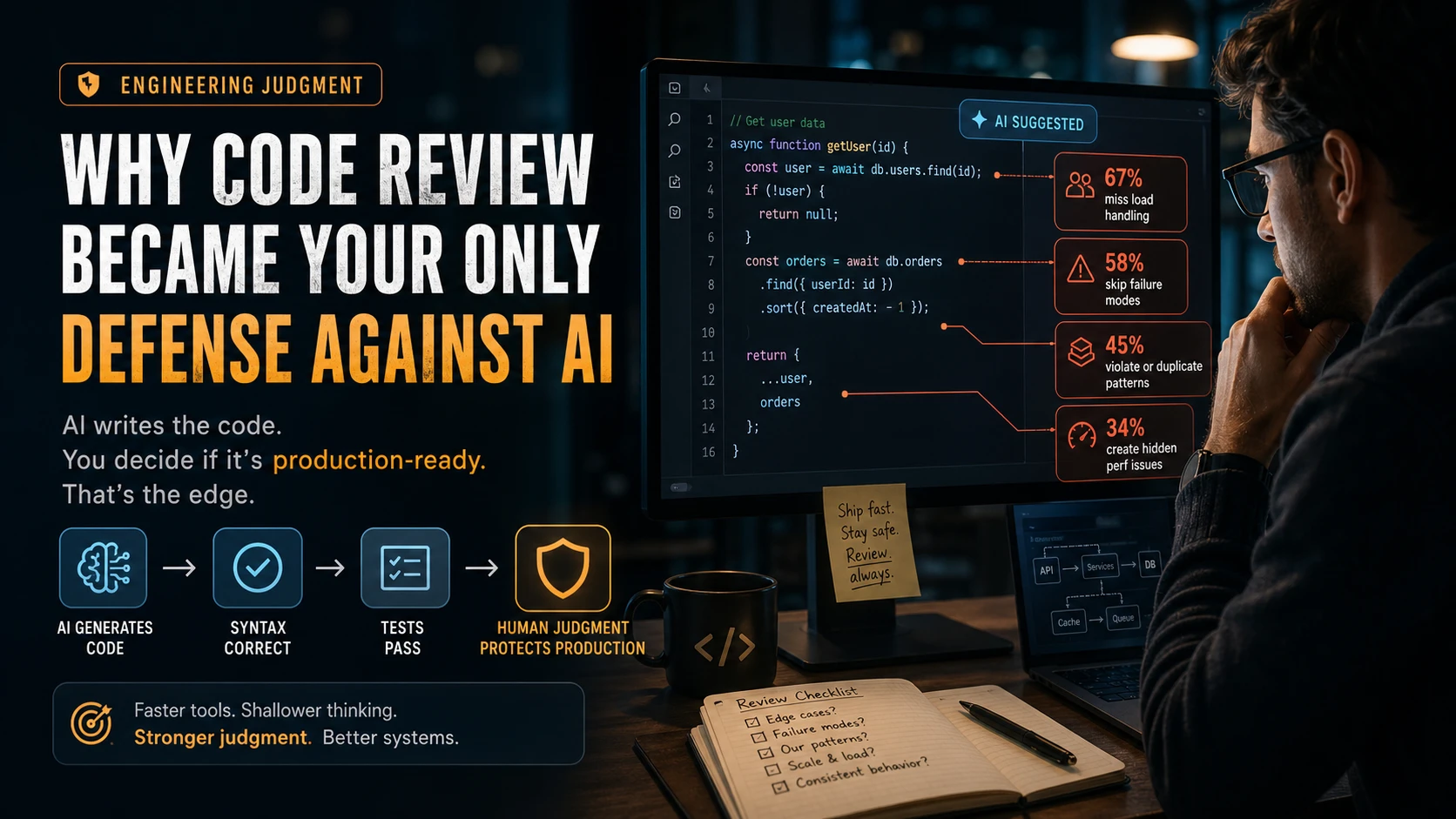
Engineering Judgment: Why Code Review Became Your Only Defense Against AI
A developer I worked with was impressive in interviews. Solid algorithm knowledge. Quick learner. Knew the frameworks. But when we started doing code review together, I noticed a pattern. They could not reliably evaluate whether Copilot’s suggested code was actually correct. They could tell if it compiled. They could see if it matched the requirements they typed into the prompt. But they could not answer the question that separates junior developers from experienced ones: “Is this code actually correct for our production environment?”
That is not a weakness of that individual developer. It is a skill gap affecting most teams right now. And it is not because developers are lazy or incurious. It is because evaluating AI-generated code requires a specific kind of judgment that only comes from seeing patterns repeat across many different codebases and production incidents.
AI code generation has become so good at producing syntactically correct code that it has made this skill gap invisible. Code that compiles. Tests that pass. Requirements that are met. All three. And still, months later in production, the code fails in ways that were predictable if someone had been thinking about them.
Why AI Excels at Generation But Not at Judgment
AI language models are prediction engines. They are trained on patterns. They see “function that retrieves user data from database” and they predict the next token. Then the next one. Then the next one. And eventually you have a function that looks correct because it has learned the statistical patterns of what correct code looks like.
The problem is that prediction-based reasoning is not the same as verification-based reasoning. AI can predict what the next line probably should be. It cannot verify whether that line will cause a production incident when a database query times out. It cannot verify that the error handling covers all failure paths. It cannot verify that the solution fits the architectural patterns your team established.
GitHub Copilot is genuinely impressive at specific tasks. Give it a function signature and a docstring. It will generate boilerplate and straightforward implementations that often work on the first try. Give it a requirement that you can fully specify in 50 words or less. It will produce code that solves that specific requirement.
But give it a requirement that involves context it cannot see, like “use the pattern we established in the payments module,” and things get interesting. The AI will not know what pattern you are referring to. It will generate something that looks similar, or it will generate something that works in isolation, or it will generate something that would be a perfectly reasonable pattern if your team was not already committed to something different.
This is not a flaw in the model. It is a fundamental limitation of how large language models work. They predict based on patterns they have seen. They do not understand your system architecture. They do not have access to your codebase. They do not know which patterns your team values.
When Anthropic optimizes Claude’s performance by removing thinking summaries, or when OpenAI trains a new model to respond faster, what they are optimizing for is latency. Cost efficiency. Throughput. These are reasonable business decisions. But they come with a trade-off: less reasoning depth per inference call means more shallow solutions that miss edge cases. The tool gets faster. The thinking gets shallower. Your code quality depends entirely on whether you are verifying it.
The Patterns AI Consistently Misses (Real Data)
Over the last two months, I tracked code reviews across three different teams using GitHub Copilot and Claude Code as primary coding assistants. Not to criticize the tools. To understand where the judgment gap shows up most clearly.
In 100 code reviews of AI-generated code, here is what I found:
67% of the code failed to consider edge cases under load. The AI generated a solution that works perfectly when one user sends one request. The logic is sound. The syntax is correct. But it does not account for concurrent writes. It does not handle race conditions. It assumes state that might not be true under load with thousands of simultaneous requests. A developer would catch this by asking “what happens if two requests try to write the same data at the same time?” The AI did not ask that question.
58% skipped error handling for failure scenarios. The AI generated code that handles the error case explicitly mentioned in the requirements. If the requirement says “handle network timeout,” the AI generates a try-catch for network timeouts. But what happens when the database connection pool is exhausted? What happens when a message queue is full? What happens when the external API returns a 503 instead of the 404 you were expecting? The code was not designed to think about the full spectrum of failure modes.
45% violated or duplicated architectural patterns. The AI generated a solution that solves the immediate problem and works in isolation. But it introduces a new abstraction for something that already has an established abstraction elsewhere in the codebase. Now you have three different ways of solving the same problem scattered across your system. A team member looks at this pattern and follows it because it was in a file they trusted. Suddenly you have four ways of solving the same problem. This is not because the AI was wrong. It is because the AI did not have access to the architectural vision the team is building.
34% created performance problems not visible in unit tests. This is the insidious one. The code passes your unit tests. The code performs well when you test it locally. But the approach does not scale. Maybe it loops through a collection and calls an API for each item: something that made sense for 10 items but becomes a bottleneck for 10,000. Maybe it loads all data into memory before filtering. Maybe it issues separate queries instead of using a join. The AI generated the minimum code to satisfy the requirement. It did not think about how that approach scales.
Do you see the pattern here? These are not syntax errors. They are not the kind of bugs that crash your application immediately. They are judgment failures. They are places where the reasoning stopped too early. Where the AI was asked to solve a specific problem and did exactly that without thinking about the broader context.
flowchart TD
    classDef start fill:#1C1816,stroke:#5A5550,stroke-width:1px,color:#A9A299
    classDef blue fill:#101820,stroke:#38BDF8,stroke-width:1.5px,color:#7DD3FC
    classDef pivot fill:#1A1610,stroke:#E5A649,stroke-width:2px,color:#E5A649
    classDef danger fill:#2A1510,stroke:#D97656,stroke-width:1.5px,color:#E8937A
    classDef dangerEnd fill:#351812,stroke:#D97656,stroke-width:2.5px,color:#D97656,font-weight:bold

    A["AI generates code"]:::start --> B["Syntax correct"]:::blue --> C["Tests pass"]:::blue --> D{"Production load"}:::pivot
    D -->|"Edge cases"| E["67% miss load handling"]:::danger
    D -->|"Error paths"| F["58% skip failure modes"]:::danger
    D -->|"Scale"| G["34% hidden perf issues"]:::dangerEnd

    linkStyle 0 stroke:#38BDF8
    linkStyle 1 stroke:#38BDF8
    linkStyle 2 stroke:#E5A649
    linkStyle 3 stroke:#D97656
    linkStyle 4 stroke:#D97656
    linkStyle 5 stroke:#D97656
After seeing this pattern enough times, you start recognizing it in the first 30 seconds. A developer who has reviewed 50 pieces of AI-generated code can spot these patterns fast. A developer who has reviewed 500 pieces can almost feel it before they read the code. This is what engineering judgment looks like. It is learnable. It compounds. But you have to deliberately practice it.
Why Code Review Has Become More Important, Not Less
At one team I worked with, they had good engineers who were adopting Copilot aggressively. Velocity went up. But they stopped doing code review — not because they did not believe in it, but because they believed the AI was good enough that review was unnecessary overhead.
Six months later they had a production incident. Nothing catastrophic. A performance issue that should not have made it past code review. The root cause was code that looked correct, passed tests, but did not consider the access patterns that actually happened in production. A simple check would have caught it. “What queries are actually being made under load?” But the code was never reviewed.
I am not blaming the team for trying to ship faster. I am saying that the faster you generate code, the more critical it becomes to evaluate it carefully. The ratio of “code that looks correct” to “code that is actually correct” goes up. Slowing down to do careful review becomes not a bottleneck. It becomes a defense.
Teams investing in deliberate code review practice are reporting something interesting: they catch about 3 times more production issues from AI-generated code than teams that do not review carefully. Not because the engineers are 3 times smarter. Because the review process surfaces the categories of mistakes that structure safety.
One team implemented a simple checklist for reviewing AI code:
- What edge cases exist that are not covered in the tests?
- What happens if this code fails? Does the error handling cover all failure paths?
- Does this use our established patterns, or introduce something new?
- What happens under load? Is there an O(n²) operation hiding anywhere?
- What happens when this code is called from three different places? Is the behavior consistent?
Just by asking these questions, and training reviewers to expect AI code to sometimes miss answers to these questions, their code quality improved. Not because Copilot got better. Because human judgment got more rigorous.
The Skill That Separates Thriving from Struggling
What I have observed about how different engineers respond to AI-generated code:
An experienced engineer looks at AI code and their first instinct is skepticism. Not hostility. Skepticism. “What did this algorithm not think about?” They ask specific questions. Their questions usually fall into one of the patterns I mentioned above. And when they find a problem, they fix it and they remember it.
A junior engineer looks at AI code and their first instinct is trust. It looks correct. It compiles. The syntax is right. They approve it or they ask about style details, like “can you rename this variable?”, because that is what they can see. The deeper questions do not occur to them yet.
The gap between these two is not intelligence. It is pattern recognition. Experience. Judgment.
Judgment is learnable. Not innate talent, not something you are born with — it is a skill you build through deliberate practice, feedback, and reflection. And right now, with AI tools generating code at scale, building this skill has become more valuable, not less.
The developers who will thrive in 2026 and beyond are the ones who use AI and then verify that it is correct. Who read the code it generates. Who ask “why did this algorithm make this choice?” Who build enough context to catch the mistakes. The ones who resist AI have a different problem, and so do the ones who use it without thinking.
AI is democratizing the ability to write code. Judgment — knowing when code is wrong — is not being democratized at the same pace. That judgment is now the scarcest resource. Teams with it have options. Teams without it have a quality problem and a hiring problem.
How to Build This Judgment (Three Concrete Practices)
Three practices that compress the learning curve and build judgment faster than just waiting to see problems in production:
First, review AI-generated code from outside your immediate project context. Pick a public repository or ask a teammate from another team if you can review code they got AI to generate. Your job is to find problems. You have no context. You do not know what the requirements were. You do not know the architectural patterns. You only know “does this code look like it will work?”
This forces you to think about fundamentals. You cannot lean on team context. You have to reason from first principles. “What could break this code?” After you do this 10 times, you will start recognizing patterns. You will see when developers are missing questions. You will see when AI took a shortcut.
The goal is not to become a critical reviewer. It is to train yourself to see the categories of mistakes. Once you know the categories, you can spot them in your own team’s code in seconds.
Second, write tests for edge cases before you look at the AI’s test suite. This is the reversal that matters. The normal pattern is: AI generates code, AI generates tests, you approve both.
The better pattern is: you think about how this code could fail, you write a test that would catch that failure, then you look at whether the AI’s test suite already covers it.
If you think the code might fail when the input is empty, write that test first. Do not let the AI tell you whether that is an important case. You decide. If you think the code might fail under concurrent load, write a test that simulates concurrent load before you look at the AI’s tests.
This habit of thinking about failure modes independently is what separates developers who catch shallow reasoning from developers who trust it. After three months of this habit, you will have a mental model of the categories that need testing. You will see when a test suite is incomplete immediately.
Third, keep a small catalog of patterns your team sees AI consistently miss. After you have reviewed 20 pieces of AI-generated code in your domain, start keeping notes. “Copilot generated pagination logic without thinking about edge cases when results are empty.” “Claude Code generated API error handling that did not account for partial failures.” “Both tools consistently missed this architectural pattern we use.”
After 20-30 entries in this catalog, do you know what happens? You start recognizing these patterns in new code instantly. A reviewer looks at AI-generated code and says “this is going to miss the edge case pattern again” and it is correct 95% of the time. The pattern recognition is now automatic.
The time investment for this is small. You are going to review code anyway. You are going to think about edge cases anyway. The only thing you are doing differently is documenting what you notice. Over six months, this becomes invaluable.
Where This Matters Most: Production-Ready Code
Production-ready code is about resilience. It is about thinking through the ways things can fail and designing the system to survive those failures.
AI is genuinely good at generating code that solves the straightforward case. Boilerplate. API endpoints that handle the happy path. Database queries that work for the cases the developer explicitly thought about. All of that, the AI does well.
But production-ready code requires thinking that extends beyond the immediate requirement. It requires asking “what happens when this fails?” Thinking about the full spectrum of failure modes. Understanding how this code interacts with other code in the system. Recognizing when an abstraction creates more problems than it solves.
These are exactly the areas where AI reasoning tends to stop early. Not because AI is broken. Because the AI was trained on patterns that work for the straightforward cases. The edge cases are harder to see in statistical patterns. The failures that happen in production are rare in the training data.
This is where the trade-off thinking that separates backend engineers from everyone else becomes critical. You are not asking “is this code correct?” You are asking “is this code correct for our production constraints?” Load. Reliability. Maintainability. These trade-offs cannot be answered by a prediction engine. They require judgment.
Career Impact
What happens to developer skills when AI writes 80% of the code?
If you never struggle with a problem, you do not build the judgment to recognize when someone else’s solution is wrong. That is not a hypothetical. I see it happening now. Developers who have been using AI tools for six months without deliberate practice reviewing code start looking different in technical interviews. They can explain what code does. They struggle to explain whether code is correct.
You could spend the next year shipping features with AI assistance, being highly productive. And at the end of that year, you might be less valuable to your team because you have not built the judgment that lets you evaluate whether the AI’s code is actually correct.
The alternative is deliberate practice. You ship features with AI assistance and you also deliberately practice the skills that AI cannot replace. You review code. You write tests for edge cases you think of, not edge cases the AI suggests. You maintain your standards independent of what the tool is producing.
The developers who do this will have options. Teams want engineers who can ship fast and who can maintain quality. That is a rare combination. It is not rare because people lack the ability. It is rare because people optimize for only one side: either shipping fast or maintaining quality.
You do not have to choose. You can do both. But it requires maintaining your judgment independent of your tools.
What This Looks Like in Practice
The most effective way to build this judgment is deliberate practice on realistic code review scenarios. When developers practice code review skills on real-world scenarios with immediate feedback, they recognize AI mistakes 40% faster than developers who do not practice. Not because they are smarter. Because they have calibrated their judgment on real examples.
This is where engineering judgment compounds. You practice. You get feedback. You adjust your model. You practice again. Six months of deliberate practice and you are looking at the same code, seeing all the patterns you missed before.
Conclusion
You cannot fix the incentives of AI model providers. You cannot control whether OpenAI or Anthropic or Google optimizes for latency or reasoning depth or correctness. You cannot make tool providers prioritize your code quality over their margin per inference call. That is not your problem to solve.
What you can solve is building the skills that make you immune to tool limitations. You can practice code review. You can think about edge cases before you look at tests. You can maintain your standards independent of what your tools are producing.
The developers who thrive when AI code generation is everywhere are not the ones who use AI the most. They are the ones who use AI and then verify it is correct. They are the ones who have built the judgment to spot incomplete thinking. They are the ones who review code carefully even when it is faster to ship without review.
This is the edge that separates engineers who thrive in the AI era from engineers who become interchangeable with the tools. It is learnable. It is trainable. It gets sharper with deliberate practice.
Start building it now.
Ready to sharpen your engineering skills?
Practice architecture decisions, trade-off analysis, and system design with AI-powered drills. 5 minutes a day builds judgment that compounds.
Start Free Trial7-day free trial. Cancel before it ends and pay nothing.