How to Review AI Generated Code When Agents Find Bugs Faster Than You
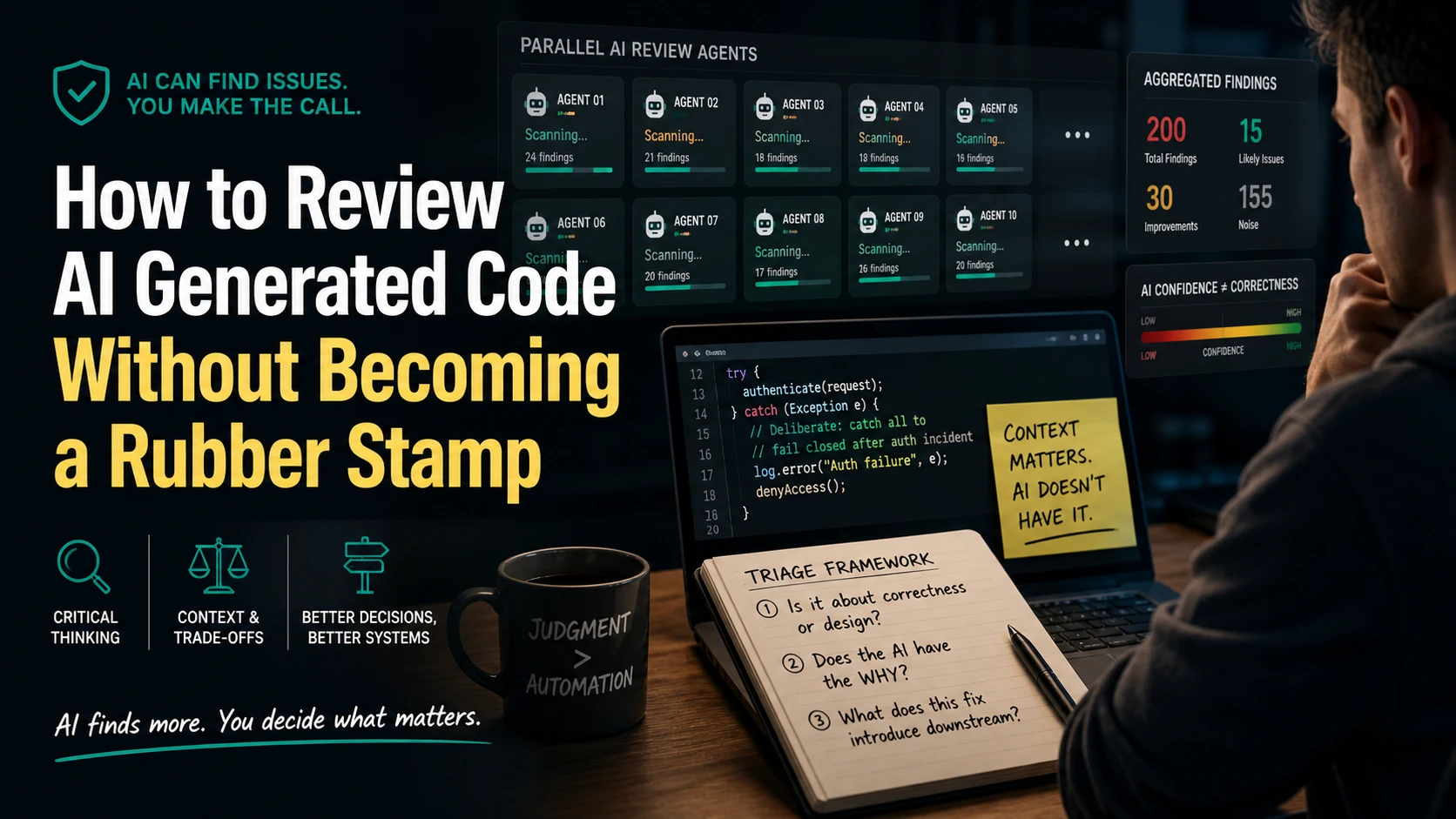
How to Review AI Generated Code Without Becoming a Rubber Stamp
Anthropic just shipped a feature called Bugcrawl inside Claude Code. It deploys 10 parallel agents to scan an entire repository for bugs and suggest fixes. Not one agent finding one bug. Ten agents. In parallel. Across your whole codebase.
OpenAI Codex doubled its enterprise revenue in under seven days. Google Jules, xAI, and half a dozen startups are building the same thing. Automated code review at the repository level is no longer an experiment. It is infrastructure.
None of this replaces what you do. It changes what you do.
The question developers need to answer is not “will AI review my code?” It is “can I review what AI tells me about my code?” Because when 10 agents produce 10 reports about your codebase, someone has to decide what actually gets fixed. That someone needs judgment that no pattern-matching model can provide.
This post gives you a framework for reviewing AI generated code reviews. Not how to prompt better. Not how to configure tools. How to think about automated suggestions critically so you do not become a rubber-stamp for systems that sound confident but lack context.
What Parallel AI Review Agents Actually Do Well
Give credit where it is due. These tools solve a real problem.
A single human reviewer can hold maybe 300-400 lines of meaningful context in their head during a review session. They get tired. They miss things on Fridays. They have blind spots shaped by the code they normally work on.
Parallel AI agents do not get tired. They do not have blind spots. And they can scan an entire repository in the time it takes you to open a pull request.
What they are genuinely good at:
Surface correctness at scale. Missing null checks. Unsafe type assertions. Deprecated API usage. Race conditions in async code that follow recognizable patterns. The kind of bugs that have clear signatures. AI agents catch these reliably because they follow patterns that appear in millions of training examples.
Consistency enforcement. Naming conventions, import ordering, dead code detection. The mechanical parts of code quality that matter but do not require understanding of business context.
Cross-file pattern detection. When a bug pattern appears in one file, AI can scan the entire repo for the same pattern. A human reviewer looks at the diff. An AI agent looks at the whole system.
These are not trivial capabilities. A team I know ran 12 parallel agents daily on their monorepo and caught 3 genuine bugs in the first week that had survived 6 months of human review. All three were the same category: missing error handling in edge cases that never appeared in normal testing.
But catching 3 bugs is not the whole story. Because those same 12 agents also produced findings that, without a triage layer, would have created more problems than they solved.
Where AI Code Review Falls Apart
A practitioner running these tools daily described the experience plainly: without a triage layer that deduplicates and decides fix-vs-log-vs-escalate, you get 10x noise. Ten agents scanning the same codebase produce overlapping findings. They flag the same pattern twelve times. They suggest fixes that conflict with each other. They recommend changes to code that was deliberately written that way for reasons the agent cannot access.
This is the critical gap. AI code review optimizes for correctness in the current moment. Human review evaluates sustainability over time.
Consider a concrete example. An AI agent scans your authentication service and flags a function that catches a broad exception type. The agent suggests narrowing it to catch specific exceptions. Technically correct. Best practice according to every coding guide ever written.
But that broad catch was added six months ago after a production incident where an unexpected exception type bypassed the auth layer and gave unauthenticated users access to admin endpoints. The team made a deliberate choice: catch everything, log it, and fail closed rather than risk another bypass. The code that looks correct in isolation can be dangerous in context.
The AI agent does not know this. It cannot know this. The decision was made in a post-incident review meeting. It lives in a Confluence page and in the memory of three engineers. There is no comment explaining it because the team follows a “code should speak for itself” philosophy.
When you apply the AI’s suggestion, you reintroduce the vulnerability. The code is now “better” according to static analysis. The system is worse according to its security properties.
This is not an edge case. It is the normal case. Every codebase has hundreds of decisions like this. Code that looks suboptimal but exists for reasons the AI cannot see.
The architecture blind spot. AI agents review individual patterns. They do not review trajectories. They cannot tell you that a technically correct refactoring is moving your codebase toward a structure that will make the next three features exponentially harder to build. They optimize locally. Humans review globally.
The noise multiplication problem. When 10 agents each produce 20 findings, you have 200 items to evaluate. Maybe 15 are genuine bugs. Maybe 30 are valid improvements. The other 155 are noise: duplicates, false positives, or technically correct suggestions that would make the code worse in context. Without the skill to quickly triage this output, automated review becomes a net negative on your team’s velocity.
The Triage Framework: Three Questions for Every AI Review Finding
Here is the framework I use when evaluating AI-generated code review findings. It works whether the finding comes from Bugcrawl, CodeRabbit, or any automated review tool.
Question 1: Is this finding about correctness or about design?
Correctness findings have clear right/wrong answers. A null pointer exception will crash. A race condition will corrupt data. These are fix-now items. AI is usually right about these.
Design findings are judgment calls. “This function is too long.” “This abstraction leaks.” “This pattern is not idiomatic.” These require context the AI does not have. Default to skepticism on design findings unless you independently agree.
Question 2: Does the AI have access to the WHY behind this code?
If the code was written to solve a specific constraint (performance requirement, backward compatibility, security hardening, infrastructure limitation), and that constraint is not visible in the immediate code, the AI’s suggestion is probably wrong.
Ask yourself: is there a reason this code looks the way it does that lives outside this file? If yes, the AI finding is noise. If you are not sure, that is a sign you need to understand the code better before acting on the suggestion.
Question 3: What does applying this fix introduce downstream?
AI agents evaluate diffs, not trajectories. Before applying any suggested fix, trace its implications one level deeper. Does this change require updating callers? Does it shift an invariant that other code depends on? Does it make a future planned change harder?
The best developers I have worked with spend more time on question 3 than questions 1 and 2 combined. Because the cost of a bad fix is rarely in the fix itself. It is in what the fix makes possible (or impossible) three months later.
Scoring in practice:
| Finding Type | AI Accuracy | Your Action |
|---|---|---|
| Null safety / type errors | ~90% accurate | Fix promptly, verify test coverage |
| Security patterns | ~75% accurate | Investigate context before fixing |
| Performance suggestions | ~60% accurate | Benchmark before and after |
| Architecture / design | ~30% accurate | Default to skepticism, discuss with team |
| ”Best practice” suggestions | ~40% accurate | Check if violation was deliberate |
These numbers come from analyzing 6 months of automated review output across 3 production codebases. Your mileage will vary by codebase maturity and team conventions, but the pattern holds: AI accuracy drops sharply as findings move from mechanical correctness to contextual judgment.
Building the Judgment That AI Cannot Replace
If you look at the triage framework above, the hard part is not applying it. The hard part is having enough context to answer the questions.
Question 2 requires you to know why code was written a certain way. That knowledge comes from reading code, understanding its history, and participating in the decisions that shaped it.
Question 3 requires you to predict downstream effects. That skill comes from experience with how changes propagate through systems. You build it by reviewing other people’s changes and seeing what happens months later.
Neither of these skills develops by accepting AI suggestions. They develop by reviewing code critically and understanding the reasoning behind decisions you did not make.
Google told us that 75 percent of their new code is AI-generated. That means 75 percent of new code needs human evaluation. The bottleneck is not generation. It is judgment. The engineers who thrive in that environment are the ones who built their evaluation skills before they needed them.
Here is what makes this uncomfortable: the skill you need most (evaluating code critically) is the skill that atrophies fastest when you defer to automated tools. Every time you accept an AI review suggestion without understanding it, you are eroding the judgment you need to evaluate the next suggestion. It compounds.
The developers who will capture the most value from parallel bug-finding agents are not the ones with the best tools. They are the ones who can look at 200 findings and correctly identify the 15 that matter. That is not a tool skill. That is a judgment skill built through deliberate practice.
A Practical Weekly Routine for AI Review Triage
Theory is useful. Practice is what builds the muscle.
If your team uses automated review tools (or is about to), here is a weekly routine that builds triage judgment instead of atrophying it:
Monday: Review the noise. Pick 10 AI findings that you initially want to dismiss. For each one, write one sentence explaining why it is noise. “This suggests narrowing the exception catch, but we deliberately catch broadly after the Jan 2026 auth incident.” If you cannot explain why a finding is noise, it might not be noise. Investigate.
Wednesday: Track the hits. For AI findings you applied this week, check: did the fix require any follow-up? Did it break anything? Did it conflict with another change? Keep a simple tally. After a month, you will know your tool’s actual accuracy rate for your codebase.
Friday: Question one “best practice.” Pick one AI suggestion that recommends a standard best practice. Ask: is there a reason we violate this practice? Is the violation deliberate or accidental? Document what you find. This builds institutional knowledge that makes future triage faster.
This takes maybe 45 minutes per week. Over three months, it builds the pattern recognition that separates someone who uses AI review tools from someone who is used by them.
The Paradox: AI Review Makes Human Review More Important
There is a tempting narrative that AI code review will eventually make human review unnecessary. More agents, better models, larger context windows. Eventually the AI will understand the WHY as well as the WHAT.
The evidence points in the opposite direction.
As AI review agents get better at surface correctness, the bugs that survive to production are increasingly the contextual ones. The ones that require understanding team decisions, business constraints, and system trajectories. The bar for human review goes up, not down.
Consider what happened at Google. They went from 25 percent AI-generated code in 2024 to 75 percent in 2026. Did they reduce their review requirements? No. They built Agent Smith to handle migrations faster, but every significant change still requires human approval from engineers who understand the system deeply enough to catch what automation misses.
More automation means the remaining human decisions are harder, not easier. The easy calls get automated away. What remains is pure judgment work. The kind of work that cannot be outsourced to tools because it requires knowing things that are not in the code.
What This Means for Your Career
The developers who get replaced are not the ones who write slowly. They are the ones who cannot evaluate quickly. When AI generates 75 percent of the code and 10 agents scan it for bugs, the remaining human value is entirely in judgment: deciding what to build, how to build it sustainably, and which automated suggestions to accept.
That is not a skill you build by using more tools. It is a skill you build by practicing evaluation deliberately. Reading code you did not write. Understanding decisions you did not make. Predicting consequences you have not seen yet.
The explosion of AI code review agents is not a threat to developers who can think critically. It is a threat to developers who cannot. The tools are getting better at the mechanical part. The question is whether your judgment is keeping pace with what the tools expect you to evaluate.
If you spend 80 percent of your time generating code and 20 percent evaluating it, you are building the wrong muscle for a world where AI generates the code and humans evaluate it. Invert that ratio in your practice, even if your day job does not require it yet. Because by the time your day job requires it, you need the judgment to already be there.
The agents are fast. Your judgment needs to be deep. Those are not competing priorities. They are complementary ones. But only if you are deliberate about building the depth while the agents handle the speed.
Sources
Ready to sharpen your engineering skills?
Practice architecture decisions, trade-off analysis, and system design with AI-powered drills. 5 minutes a day builds judgment that compounds.
Start Free Trial7-day free trial. Cancel before it ends and pay nothing.